
Feb 2026: Navigating IT Hardware Supply & Pricing
Global IT supply chains continue to experience ongoing disruption. Pricing volatility, extended lead times, and uneven availability are now part of the reality for infrastructure projects across all industries.
What to know, what to expect, and how Focus Group Technologies can help
IT hardware supply & pricing in Australia continues to be impacted by global disruption across infrastructure markets.
These conditions are not the result of decisions made by any single vendor, distributor, or reseller. They are being driven by sustained, unprecedented global demand for compute, storage, memory, and GPU capacity, particularly from large-scale AI environments (Open AI, Microsoft, Amazon etc.) combined with constrained manufacturing capacity in key component categories.
Independent analysis from Gartner reinforces this position, describing the current shortages in DRAM and NAND flash as structural rather than cyclical, with volatility expected to persist well into 2027. This insight focuses on IT hardware supply & pricing Australia and how organisations can plan around ongoing volatility.
While these market forces are outside the direct control of vendors, how infrastructure is planned, specified, and sourced now makes a significant difference. Our role is to help customers make informed, low-risk decisions by providing current market insight, practical alternatives, and realistic timelines.
The most successful projects we are seeing share one thing in common: early engagement paired with flexible, intentional design.
The following outlines what we are seeing, what it means in practice, and how we support you through it.
Why are IT hardware prices increasing?
Pricing pressure is being driven by global component shortages, higher manufacturing and logistics costs, because of sustained and unprecedented demand for infrastructure from hyperscale and AI platforms.
These impacts are industry-wide and affect nearly all vendors and product categories. Importantly, vendors themselves are operating under allocation constraints imposed upstream at the component and fabrication level.
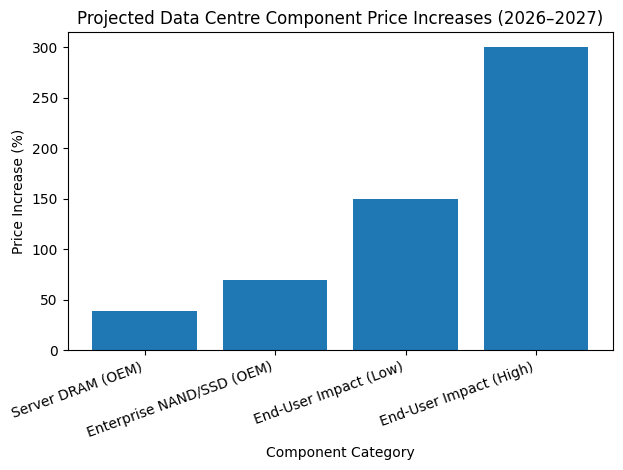
Gartner notes that server DRAM and NAND pricing increases are being driven by a reallocation of manufacturing capacity toward AI-optimised products, rather than discretionary vendor pricing decisions.
Which components are most affected?
The most common pressure points are:
- Enterprise SSD and NVMe storage
- High-capacity RAM (DDR4 and DDR5)
- Server and workstation GPUs
- Certain CPUs and networking components
For example, we have seen laptop and desktop pricing increase by 20–50%, and server components, particularly memory, more than double within a matter of months in some configurations.
These movements align with Gartner’s projection that end-user memory and storage pricing may increase 150–300% into 2027 as shortages persist.
Why do quotes have shorter validity periods?
Vendor pricing and availability positions can change quickly as component allocations shift. Shorter quote validity periods help ensure pricing remains accurate and reduce the risk of unexpected changes after approvals are given.
Gone are the days of 3- or 6-month quote validity. Most infrastructure pricing is now valid for 1–2 weeks, or end-of-month at best, depending on component exposure.
Can projects still move forward under these conditions?
Yes. With the right planning, most projects can proceed successfully.
In many cases, alternative components, revised architectures, or phased delivery approaches allow timelines and budgets to be met despite current constraints. Finance options may also allow you to achieve business objectives where previously not considered.
Is it better to wait for prices to improve?
Sometimes, but not always.
Waiting can reduce risk in certain scenarios, but it can also increase exposure if lead times extend further or pricing worsens. There is no single stabilisation date. Some component categories will improve sooner, while others may tighten unexpectedly.
Gartner’s view is that selective action, rather than blanket delay, produces better outcomes, particularly when decisions are grounded in workload requirements and current market conditions rather than historical pricing assumptions.
Our role is to monitor conditions continuously and advise you based on current market reality, not outdated assumptions
How Focus Group Technologies helps during this period
We aim to act as an advocate and advisor by:
- Monitoring real-time supply, pricing, and allocation conditions
- Designing solutions around constrained components
- Managing vendor communication and expectation-setting
- Helping prioritise what to order early and what can safely wait
- Helping prioritise what to order early and what can safely wait
Our goal is to reduce uncertainty and keep projects moving, even when market conditions are challenging.
What should you do if you have a project starting in the next 3–6 months?
Engage early.
Early discussions allow us to:
- Identify long lead-time or high-risk components
- Lock pricing or allocation where possible or advise on realistic validity windows
- Offer alternative designs before constraints become critical
- Align procurement with achievable delivery timelines
- Help set expectations within your business early
Even if requirements are not final, early visibility provides more options, fewer surprises, and better outcomes.
If you have upcoming infrastructure initiatives or would like to sanity-check an existing plan against current market conditions, we encourage you to reach out. We’re here to help you navigate this environment with clarity and confidence.
Focus Group Technologies
Clear guidance. Market realism. Infrastructure that moves forward.
Additional reading for broader context and better understanding
Tom’s Hardware: Perfect storm of demand and supply driving up storage costs
https://www.tomshardware.com/pc-components/storage/perfect-storm-of-demand-and-supply-driving-up-storage-costs
Reuters — AI frenzy is driving a new global supply chain crisis
https://www.reuters.com/world/china/ai-frenzy-is-driving-new-global-supply-chain-crisis-2025-12-03